The Overwhelmed Mind
For days when thoughts race and screens burn your retinas. Minimalist philosophy, nature prose, and cognitive steadying.
Meditations · Stillness Is the Key · Calm the Chaotic Mind
Most book apps are popularity contests — bestseller rankings, affiliate commission loops, and star ratings that ignore your state of mind. Book Is Your Friend starts from how you feel and matches you to concise, 15–20 minute spoken audio summaries with synced transcripts based on real psychological needs. Spoken audio available in Hindi and English, with native dual-script reading.

Tap through the core surfaces of Book Is Your Friend. Built with Flutter 3, Drift SQLite, and Android 16 release performance.
Rules for Focused Success · 17m
▶ Listen Now
"सफलता एक साथ सब कुछ करने से नहीं मिलती।"
"एक 2-इंच का डोमिनो अपने से 50% बड़े डोमिनो को गिरा सकता है। सफलता क्रमिक होती है।"
"हर उस अच्छी चीज़ को ना कहो जो सबसे ज़रूरी चीज़ के रास्ते में आए।"
Designed as a distraction-free sanctuary. The audio player keeps your focus centered on the ideas with synchronized chapter navigation and automatic progression.
The app reorganizes world non-fiction into human emotional needs rather than publisher categories.
For days when thoughts race and screens burn your retinas. Minimalist philosophy, nature prose, and cognitive steadying.
For crossroads and career confusion. First-principles thinking, single-focus discipline, and decision hygiene.
For when you have drive but zero traction. High-tempo behavioral psychology, kinetic execution, and micro-habits.
For quiet sorrow, burnout, and unsaid words. Grounded memoirs, emotional boundaries, and shared human endurance.
Ancient wisdom without distorted dogma. Public-domain Sanskrit shlokas mapped to modern psychological mental models.
Validated across 83,000+ competitor reviews: users leave audiobook apps when engineering fails. BYF is built offline-first with zero bloat.
Powered by just_audio and Android audio services. Survives screen locking, phone calls, navigation switches, and backgrounding without losing progress or stuttering.
Hovering glassmorphic dock anchored above the bottom navigation bar. Tap once to expand into the full player screen without re-buffering or restarting audio.
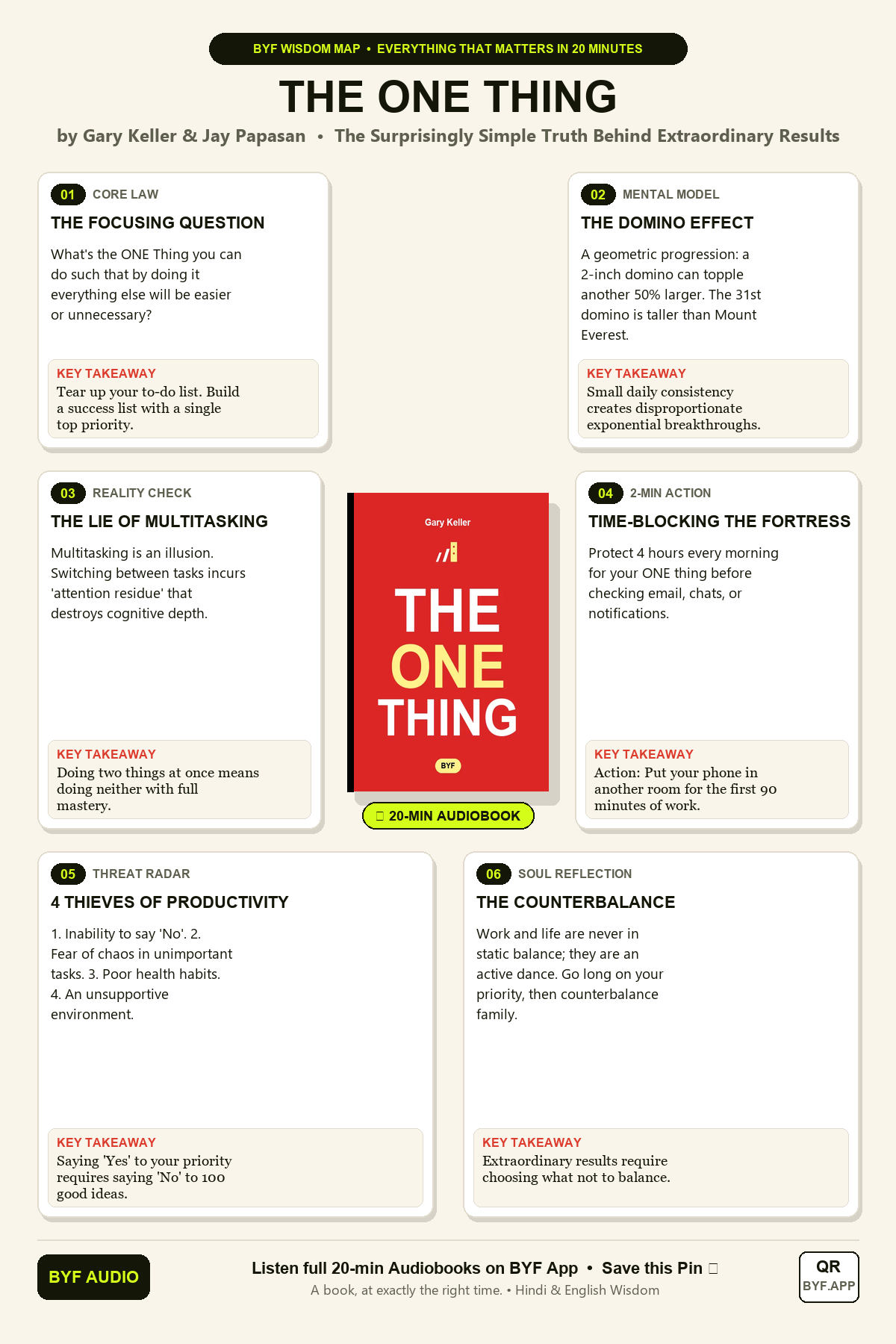
3D Y-axis cover flip on the Book Detail Screen revealing the 6-Bento collectible visual cheat sheet. Programmatic code generation renders crisp Devanagari and Latin typography in <150ms with zero server storage overhead.
Encrypted local database for reading progress and reflections. No account needed to start, zero telemetry surveillance, no mid-listen popups, no ads, and no streak shame mechanics.
Tested against 83,000+ competitor reviews — we eliminated deceptive auto-debits, recurring mandates, and hidden costs.
Audio narration is available now in Hindi and English. Full written scripts are available across both languages with instant native ⇄ Roman script toggling for effortless mobile reading.
Thoughtful Devanagari scripts and spoken audio with natural conversational cadences for modern Indian readers.
Clean, unhurried, global non-fiction synthesis focused on depth, nuance, and actionable cognitive clarity.
BYF is undergoing final internal release validation on physical Android 16 hardware (API 36). The production build features 12 fully narrated master audiobooks in Hindi & English, 331 verified wisdom cards, and our Pay Once · No Auto-Renew model via one-time UPI or Card payment.
"Don't just read books. Let books steady your mind."← Back to KSM × Tech Portfolio